

Experience, not flying skills, determines when young golden eagles leave their parents’ territory for good
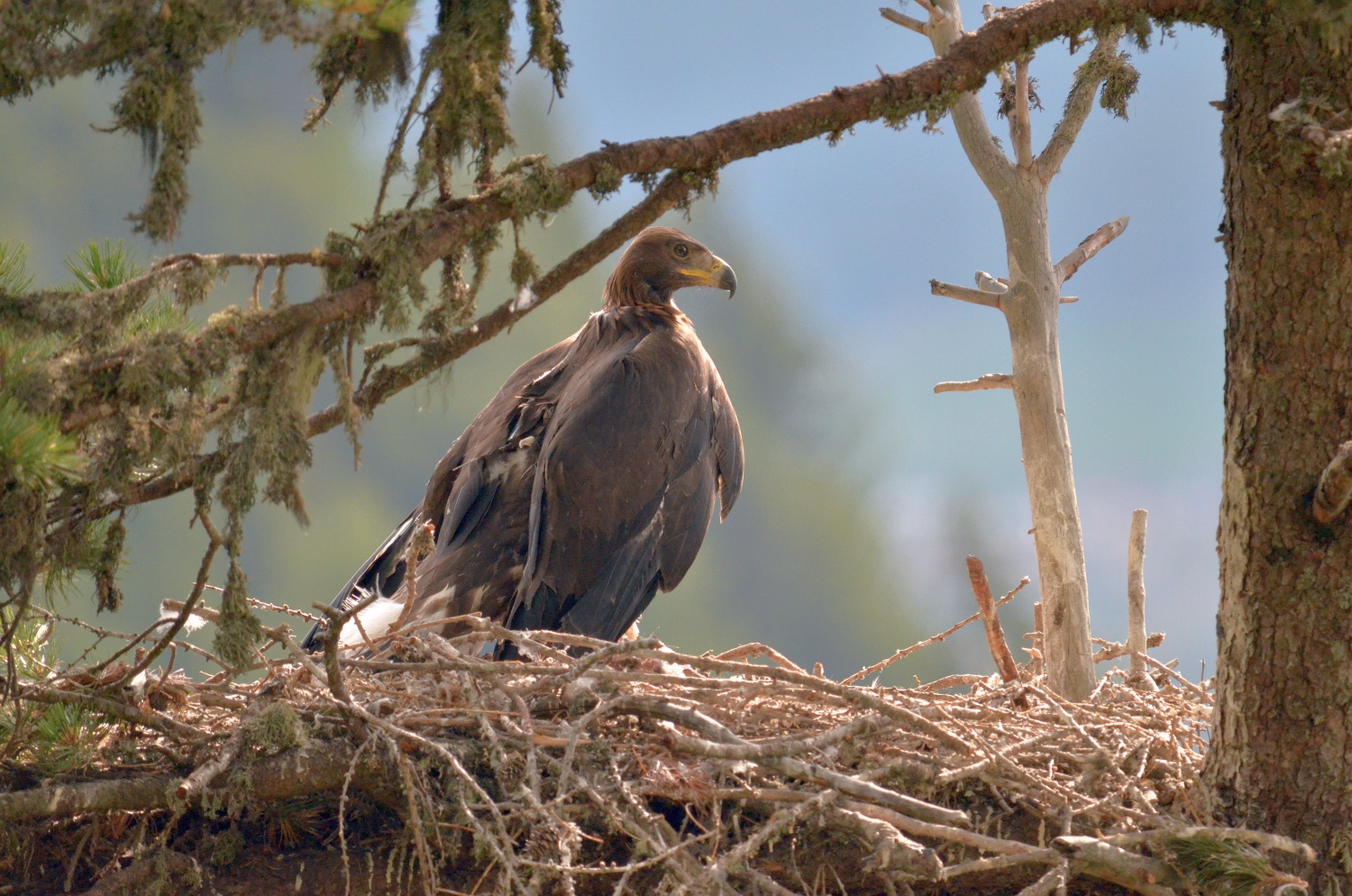
In the first few months of their lives, young golden eagles in the Alps learn how to navigate between the mountains and use thermals to soar to great heights – an essential skill for their survival. However, how quickly they acquire this ability or how skilfully they manage it does not influence the time at which they finally leave their parents’ territory. A new study of 92 young eagles fitted with GPS transmitters shows that it is the duration and altitude of their daily flights, rather than their skill in mastering thermals, that significantly influences their decision to lead an independent life. The paper has been published in the journal ‘Royal Society Open Science’.
When a young golden eagle (Aquila chrysaetos) finally leaves its parents’ territory, it leaves behind the only safety net it has ever known. Until now, biologists had assumed that eagles took this step as soon as they could fly well enough to survive on their own. However, a new study, in which 92 young golden eagles in the Alps were tracked using GPS transmitters over a period of six years, shows that flying ability has almost nothing to do with it. Just a few months after young eagles fledge, they are able to fly just as skilfully – climbing rapidly, circling in tight radii whilst soaring on thermals, and making use of shifting winds – as adult eagles. Nevertheless, many remain in their parents’ territory for almost a whole year afterwards. “Golden eagles seem to be able to fly well long before they leave their parents’ territory,” says Dr Hester Brønnvik, lead author of the study. She conducted this study at the Max Planck Institute of Animal Behavior and is now a scientist in the Department of Evolutionary Ecology at the Leibniz Institute for Zoo and Wildlife Research. “Being able to survive on one’s own and actually taking that step are clearly two different things.”
The study was carried out by the Max Planck Institute of Animal Behavior and the University of Konstanz in collaboration with the Swiss Ornithological Institute, the Swiss Federal Institute for Forest, Snow and Landscape Research (Switzerland), the Konrad Lorenz Research Centre at the University of Vienna (Austria) and the Centro Italiano Studi Ornitologici (Italy).
Reconstructing the flight capabilities of eagles using high-resolution GPS data
Between 2019 and 2024, the team fitted young golden eagles in the Alps with GPS tags and tracked each bird’s movements from the age of around 50 days – that is, shortly before it left the nest – during its first forays outside its parents’ territory and, in most cases, right up to the day it finally emigrated. Most eagles undertook their first journey outside their parents’ territory within about three months of being tagged, covering distances of up to 77 kilometres, sometimes on excursions lasting several days. Studies from other regions suggested that golden eagles reach their full adult flying ability at precisely this age. However, this was not followed by emigration; many birds did not leave their parents until almost a year after being tagged, and often only after winter had ended. “These young eagles were clearly capable of surviving outside their parents’ territory long before they actually left it,” says Brønnvik. “They were already undertaking flights of dozens of kilometres and staying away for days at a time. They simply kept coming back.”
To analyse their flying abilities, the transmitters sent short bursts of GPS data at a resolution of one location per second. This enabled the scientists to reconstruct exactly how each eagle soared: how tightly it circled in thermal updrafts, how quickly it gained altitude, and how well it coped with the wind. The team wanted to know whether the birds that mastered flying in thermals the quickest were also the ones that left home the earliest. “These skills proved to be necessary, but were by no means sufficient,” says Dr Elham Nourani of the Max Planck Institute for Animal Behavior and the University of Konstanz, one of the study’s lead authors. “The decision to leave the parental territory depends on much more than just whether one has the necessary skills for flight and hunting.” None of the detailed measures of the eagles’ flying skills allowed the scientists to predict when eagles would undertake their first long journeys away from their home territory or when they would leave it for good.
What predicted both was another factor: how far eagles strayed from their territory during their daily forays and how high they soared into the sky. Young eagles that covered greater distances and reached greater heights were far more likely to undertake exploratory flights shortly afterwards and were the ones that eventually left the territory months later. “These daily movements capture something that soaring skill alone cannot,” says Nourani, who is now an Assistant Professor in the Department of Ecology and Evolution at the University of Lausanne. “They reflect motivation, competition, food availability and weather all at once, and it is clearly the experience of these factors that actually determines the decision to leave.”
Why young golden eagles might delay leaving their parents’ territory
The Alpine population of golden eagles studied by the team is unusual: it is saturated, meaning that almost every suitable territory is already occupied and there are only a few vacant territories that young eagles could exploit. The authors suggest that this could explain why so many young eagles delay leaving the territory, even when they are already fully capable flyers: they remain in their parents’ territory for as long as possible, rather than venturing into a competitive, overcrowded landscape where there is no guarantee of finding a place of their own.
This decoupling of skills and independence may not be limited to eagles. Similar patterns have been described in New Caledonian crows (Corvus moneduloides), which take up to a year to master tool use but don't leave home for another year after that. This has also been observed in several other species with long periods of parental care. “Independence is not necessarily a race to leave home as soon as an animal is capable of surviving”, says Dr Kamran Safi of the Max Planck Institute of Animal Behavior and the University of Konstanz, one of the study’s lead authors. “For a young eagle, the parental territory may remain the safest available place for months after it has mastered flight. Staying there, while parents still tolerate it, can provide time for small but meaningful improvements in performance and experience before entering a landscape where space is scarce and risks are high. This might eventually increase the odds to outlive competitors and survive long enough to when it is time challenging a territory holder in order to take over what they will defend, not seldom to death. Skill acquisition might just be the wrong yardstick for predicting independence in a lot of animals, including, perhaps, our own."
This study examines decision-making in animals. Factors such as the availability of food and an individual’s ability to compete successfully for it can interact and influence life-history transitions. At the Leibniz-IZW, Brønnvik has been part of the GAIA Initiative’s research team for several months and will continue to investigate how animals make decisions regarding foraging, intraspecific interactions and the rearing of their young in response to their dynamic environments. Her focus is shifting from golden eagles – which, although once persecuted, have now seen their populations recover – to African vulture species, which remain highly endangered. She is investigating how environmental conditions shape the distribution of vultures, the ecosystem services they provide, and the risks they encounter. The “GAIA-MISSION” project, part of the GAIA initiative, is funded by the German Federal Ministry of Research, Technology and Space (BMFTR). The project’s vision is to create a technological interface between the sensory capabilities and knowledge of animals and us humans, in order to achieve tangible progress in wildlife research and species conservation.
The study and the preparation of the scientific article were significantly supported by funding programmes: Elham Nourani was supported by the PRIME programme of the German Academic Exchange Service (DAAD), with funding from the German Federal Ministry of Education and Research. Hester Brønnvik received funding from the German Research Foundation (DFG). The research was partially funded by the DFG as part of the German Excellence Strategy, as well as by the Swiss National Science Foundation.
Publication
Brønnvik H, Scacco M, Chimento M, Bassi E, Fiedler W, Hatz JS, Sumasgutner P, Tschumi M, Wikelski M, Zimmermann S, Safi K, Nourani E (2026): Decoupling of emigration timing and skill acquisition in a saturated population of golden eagles. R. Soc. Open Sci. (2026) 13 (8): rsos251574. DOI: 10.1098/rsos.251574
Contacts
Leibniz Institute for Zoo and Wildlife Research (Leibniz-IZW)
in the Forschungsverbund Berlin e.V.
Alfred-Kowalke-Str. 17, 10315 Berlin
Dr Hester Brønnvik
Scientist in the Department of Evolutionary Ecology
phone: +49(0)30 5168735
email: bronnvik@izw-berlin.de
Jan Zwilling
Team Lead Science Communication
phone: +49(0)30 5168121 | +49(0)1512 6764603
email: zwilling@izw-berlin.de | presse@izw-berlin.de
University of Lausanne
Quartier Centre, 1015 Lausanne, Schweiz
Dr Elham Nourani
Assistant Professor in the Department of Ecology and Evolution
phone: +41(0)21 6924105
email: elham.nourani@unil.ch
Max Planck Institute of Animal Behavior
Am Obstberg 1, 78315 Radolfzell, BW
Dr Kamran Safi
Group Leader of Animal Environment Interactions
phone: +49 7531 945 05 25
email: ksafi@ab.mpg.de