

“Tagesspiegel” names Thomas Hildebrandt one of the 100 most important figures in Berlin science
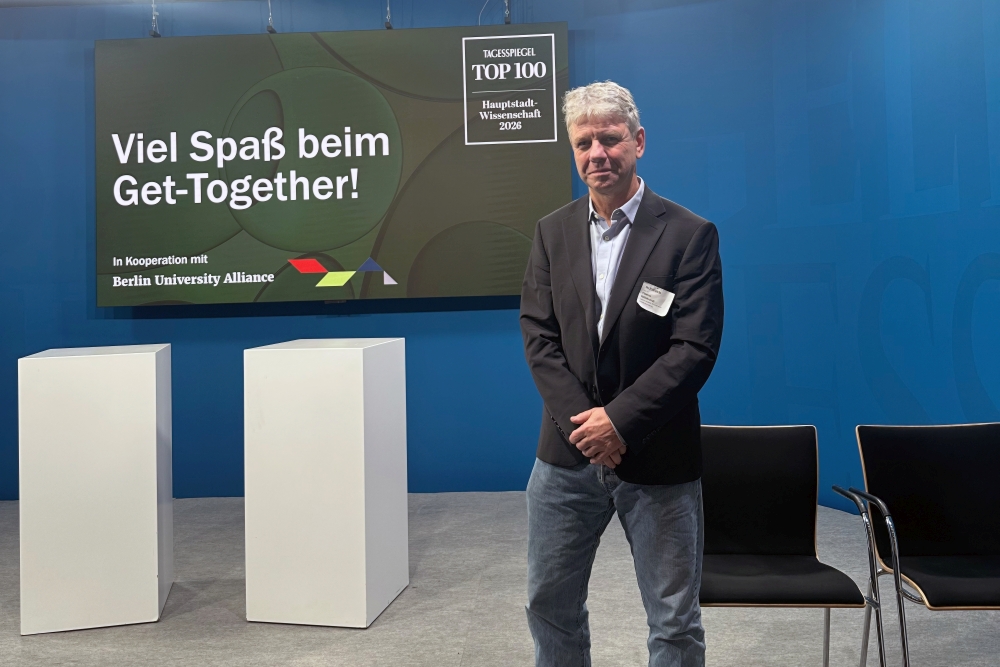
Professor Dr Thomas B. Hildebrandt, Head of the Department of Reproduction Management at the Leibniz Institute for Zoo and Wildlife Research (Leibniz-IZW), is one of the “100 most important figures in Berlin science 2026”. On 8 October, “Der Tagesspiegel” portrayed him as part of its series on scientists tackling the environmental crisis. The profile recognises the Leibniz-IZW researcher’s work to protect endangered species, including the northern white rhinoceros.
The portray focuses on Hildebrandt’s work to develop new approaches to protecting highly endangered species. He leads the international BioRescue consortium, which is researching advanced reproductive technologies and stem-cell-based approaches to save the northern white rhinoceros. Only two females of this subspecies remain, and neither can produce offspring naturally. The team creates embryos in the laboratory and transfers them to surrogate mothers of the southern white rhinoceros.
Speaking at the closing event for the Tagesspiegel series on 14 October, Hildebrandt said: “I would like to thank the Tagesspiegel editorial team for this recognition. BioRescue is partly funded by the Federal Ministry of Research, Technology and Space (BMFTR). This support is important in advancing research on such a challenging conservation project. The progress made so far would not have been possible without the expertise and commitment of everyone involved. It is a team effort, spanning countries and institutions.”
Professor Ursula Siebert, Director of the Leibniz-IZW, said: “We are very proud that Thomas Hildebrandt has been selected. His work is a fine example of the scientific excellence and capabilities of researchers at the Leibniz-IZW. Our teams combine innovative research with international collaboration and a strong commitment to conserving biodiversity.”
“I particularly wish to commend the collaboration between Kenya and our international scientific partners”, says Prof Erustus Kanga PHD, CBS, EBS, General Director of Kenya Wildife Service (KWS). “The expertise brought together by BioRescue, Zoo Dvůr Králové, Avantea Laboratories, the Leibniz Institute, the University of Padua, the Max Delbrück Center, Kyushu University, and many others demonstrates that conservation succeeds when knowledge, innovation, and partnerships come together for a common purpose.”
Hildebrandt is Professor of Wildlife Reproduction Medicine at Freie Universität Berlin and is one of the pioneers of assisted reproduction in large mammals. His research includes rhinoceroses, elephants, big cats and pandas.
“100 Figures in Berlin Science” is a ten-part Tagesspiegel series. It profiles people whose outstanding research, teaching, civic engagement or contributions to public debate are shaping science in and around Berlin.
About the Leibniz-IZW
The Leibniz Institute for Zoo and Wildlife Research (Leibniz-IZW) investigates how wildlife adapts and contributes through its research to the conservation of biodiversity. It is part of the Forschungsverbund Berlin e. V. and a member of the Leibniz Association.
Contacts
Leibniz Institute for Zoo and Wildlife Research (Leibniz-IZW)
in the Forschungsverbund Berlin e.V.
Alfred-Kowalke-Straße 17, 10315 Berlin
Prof. Dr Thomas Hildebrandt
BioRescue project leader and head of the Department of Reproduction Management
phone: +49/305168440
email: hildebrandt@izw-berlin.de
Steven Seet
Head of Unit, Strategic Communication
phone: +49 (0)1522 4573519
email: seet@izw-berlin.de
Jan Zwilling
Team Lead Science Communication
phone: +49(0)30 5168121 | +49(0)1512 6764603
email: zwilling@izw-berlin.de | presse@izw-berlin.de