
Evolution in Wild Populations: Determinants of Fitness and Environmental Change Responses of Spotted Hyenas
| Duration: | 2022 - present |
| Third-party funded: | Yes (partially) |
| Involved Department(s): | Dept Evolutionary Genetics |
| Leibniz-IZW Project Leader(s): |
Camila Mazzoni (Dept Evolutionary Genetics), Oliver Höner (Department of Evolutionary Ecology)
|
| Leibniz-IZW Project Team: |
Larissa Arantes, Oliver Höner, Camila Mazzoni
|
| Consortium Partner(s): | University of Edinburgh (Scotland) |
| Current Funding Organisation: | European Research Council (ERC) |
| Research Foci: | ● Understanding traits and evolutionary adaptations ● Developing theories, methods, and tools ● Understanding wildlife health and disturbed homeostasis |
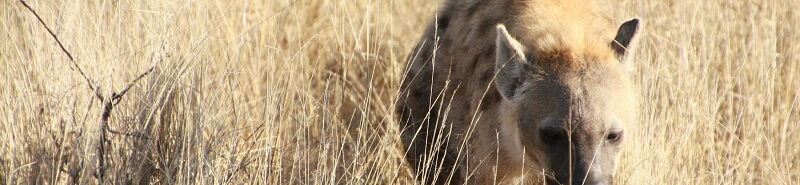
Rapid environmental change is affecting natural populations globally. This constitutes both an urgent concern, and also an opportunity to understand how environmental change shapes evolutionary and ecological responses. Focusing on the spotted hyenas inhabiting Ngorongoro Crater in Tanzania, we will combine the long-term demographic data with genomic data to investigate (1) what determines fitness, (2) how persistent distinct biological responses are to environmental change, and (3) what the consequences are for population dynamics in the wild. Using the 3RADseq method, around 30,000 SNPs were generated for about 1,200 individuals to investigate these evolutionary processes.
Selected Publications
Arantes L.S. et al. 2023. Scaling-up RADseq methods for large datasets of non-invasive samples: Lessons for library construction and data preprocessing. doi.org/10.1111/1755-0998.13859