

Press releases
The Leibniz-IZW regular publishes press releases on key findings and insights from its research and on events, awards or personalia. The press releases are distributed directly to journalists on our press release distribution mailing list. Press releases are also disseminated through the distribution services Informationsdienst Wissenschaft, AlphaGalileo and EurekAlert. Are you interested in receiving our press releases directly via e-mail? In this case please send us an email to presse@izw-berlin.de.
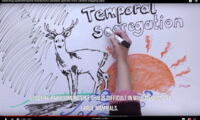
Studying species interactions using remote camera traps
Species are often involved in complex interactions with other species, which can affect their occurrence, abundance, feeding habits and disease transmission. Observing and studying species interactions can be difficult. To circumvent this problem, ecologists increasingly rely on remote devices such as camera traps. In a recent study carried out by researchers from the Leibniz Institute for Zoo- and Wildlife Research (Leibniz-IZW) in Germany and University of California, Davis, USA, the scientists explored to what extent camera trap data are suitable to assess subtle species interactions such as avoidance in space and time. The study is published in the international journal Remote Sensing in Ecology and Conservation.
Read more … Studying species interactions using remote camera traps
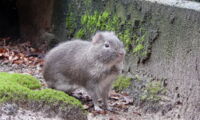
New epigenetic study reveals how guinea pig fathers pass on adaptive responses to environmental changes
Adaptations to environmental change are the most important asset for the persistence of any plant or animal species. This is usually achieved through genetic mutation and selection, a slow process driven by chance. Faster and more targeted are so called epigenetic modifications. They do not alter the genetic code but promote specialisations during cell maturation. A new study carried out by scientists from the Leibniz-IZW in Germany shows for wild guinea pigs that epigenetic modifications specific to individual environmental factors are passed on to the next generation. The study is published in the scientific journal “Genes”.
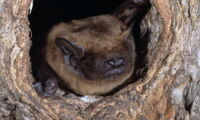
Multicultural creatures of habit – Long-term study reveals migratory patterns of bats
Every year trillions of animals migrate for thousands of kilometres between their summer and winter areas. Among them are several species of bats whose journeys in the dark of the night unfold largely unnoticed by humans and have only partially been investigated by science. A reconstruction of individual migration patterns of the common noctule (Nyctalus noctula) in Central Europe has now revealed that travelling distances vary largely among individuals, yet overall females cover longer distances than males. Local bat populations, which remain separate when females rear their offspring in summer, strongly mix in their hibernacula, the roost where they hibernate in winter. Additionally the study showed that individuals rarely change their migration habits – a behaviour that could prove problematic when bats are forced to adjust to rapidly changing ecosystems. The study was published in the „Proceedings of the Royal Society: Biological Sciences“.
Read more … Multicultural creatures of habit – Long-term study reveals migratory patterns of bats
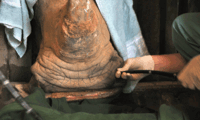
Lung lavage as new test method improves tuberculosis diagnosis in rhinoceros
Diseases and tuberculosis in particular can pose considerable challenges for wildlife. In order to avoid epidemics within populations or to treat individual animals belonging to highly endangered species, fast and reliable tests are paramount. However present tuberculosis testing in rhinos relies on skin tests developed in the 1960s and designed for cattle bearing high risk of false diagnosis in rhinos. To improve diagnostic standards an international team of scientists lead by institutes in Berlin and Jena, Germany, performed repeated lung lavage as a new approach for tuberculosis diagnosis in rhinoceros. Subsequent genetic tests reliably identified mycobacteria in the animals’ respiratory fluids – with minimal stress and risk for the rhinos. The study has been published in the journal PLOS ONE.
Read more … Lung lavage as new test method improves tuberculosis diagnosis in rhinoceros

Hyena population recovered slowly from a disease epidemic
Infectious diseases can substantially reduce the size of wildlife populations, thereby affecting both the dynamics of ecosystems and biodiversity. Predicting the long-term consequences of epidemics is thus essential for conservation. Researchers from the Leibniz Institute for Zoo and Wildlife Research (Leibniz-IZW) in Berlin and from the Center for Functional Ecology and Evolution (CEFE) in Montpellier, France, have now developed a mathematical model ("matrix model") to determine the impact of a major epidemic of canine distemper virus (CDV) on the population of spotted hyenas in the Serengeti National Park in Tanzania. The results of the study are published in the new Nature open-access journal Communications Biology.
Read more … Hyena population recovered slowly from a disease epidemic

Fading stripes in Southeast Asia: First insight into the ecology of an elusive and threatened rabbit
The Annamite mountains of Vietnam and Lao PDR (Laos) harbour exceptional species richness and endemism, but its wildlife is under threat from widespread and intensive poaching. The region is home to the Annamite striped rabbit (Nesolagus timminsi), a little-known lagomorph only discovered by science in 1995. A new study carried out by the Leibniz Institute for Zoo- and Wildlife Research (Leibniz-IZW) in collaboration with WWF-Vietnam, WWF-Laos, and the Central Institute for Natural Resources and Environmental Sciences (CRES) of the Vietnam National University, provides the first detailed information about the species ecology. The study is published in the international journal Oryx.
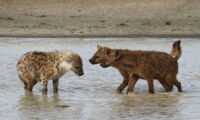
The power of social support – How female hyaenas came to dominate males
In most animal societies, members of one sex dominate those of the other. Is this, as widely believed, an inevitable consequence of a disparity in strength and ferocity between males and females? Not necessarily. A new study on wild spotted hyaenas shows that in this social carnivore, females dominate males because they can rely on greater social support than males, not because they are stronger or more competitive in any other individual attribute. The main reason for females having, on average, more social support than males is that males are more likely to disperse and that dispersal disrupts social bonds. The study by scientists of the Leibniz Institute for Zoo and Wildlife Research (Leibniz-IZW, Germany) and the Institut des Sciences de l’Evolution de Montpellier (ISEM, France) was published in the journal Nature Ecology & Evolution.
Read more … The power of social support – How female hyaenas came to dominate males
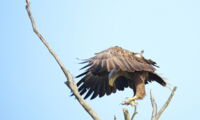
First evidence of fatal infection of white-tailed sea eagles with avian influenza
The most common unnatural causes of death in white-tailed sea eagles are lead poisoning and collisions with trains. During the winter of 2016/2017, however, many white-tailed eagles died in Northern Germany in circumstances unrelated to either cause. Instead, at least 17 white-tailed sea eagles were killed by avian influenza of the highly pathogenic virus subtype H5N8, as a team of scientists from the Leibniz Institute for Zoo and Wildlife Research (Leibniz-IZW) and the Friedrich-Loeffler-Institute (Federal Research Institute for Animal Health, FLI) demonstrated. Avian influenza may become a new threat for this highly protected wild species. The study was published in the scientific journal “Viruses”.
Read more … First evidence of fatal infection of white-tailed sea eagles with avian influenza
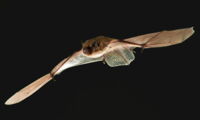
Red light at night: A potentially fatal attraction to migratory bats
Night time light pollution is rapidly increasing across the world. Nocturnal animals are likely to be especially affected but how they respond to artificial light is still largely unknown. In a new study, scientists from the Leibniz Institute for Zoo and Wildlife Research (Leibniz-IZW) in Berlin, Germany, tested the response of European bats to red and white light sources during their seasonal migration. Soprano pipistrelles (Pipistrellus pygmaeus) and, to a lesser degree, Nathusius’ pipistrelles (Pipistrellus nathusii) were recorded more frequently near red LED light, indicating that the animals might be attracted to red light during their migration. In contrast, the scientists did not observe such behaviour near white LED lights.
Read more … Red light at night: A potentially fatal attraction to migratory bats
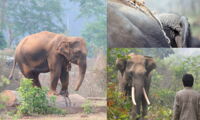
Capturing elephants from the wild shortens their lives
Humans have captured wild Asian elephants for different purposes for more than 3,000 years. This still continues today despite the fact that the populations are declining. An international team of researchers has now analysed records of timber elephants in Myanmar to understand the effects of capture on the survival of the animals. The study shows that even years after capture, the mortality rate of wild-caught elephants remains increased, and their average life expectancy is several years shorter than that of captive-born animals. This increases the pressure on free-ranging populations, if captures from the wild continue, and thus could be unsustainable in the long run. Possible differences between captive-born and wild-captured elephants, as revealed by this study, have important implications but are rarely considered in research and conservation programmes. The results have now been published in the scientific journal Nature Communications.
Read more … Capturing elephants from the wild shortens their lives