
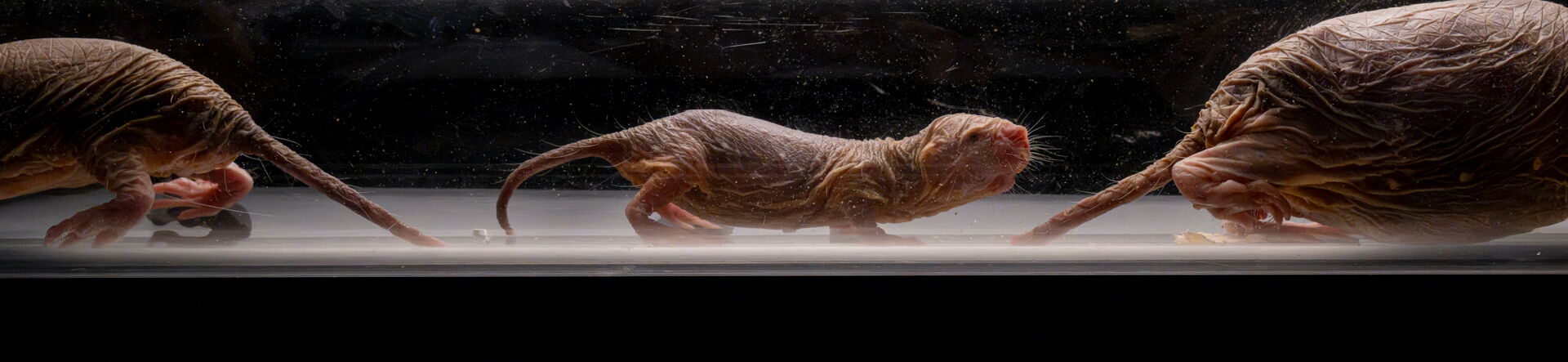
Der Nacktmull – Eine alternative Modelltierart für die biomedizinische Alternsforschung
Nacktmulle (Heterocephalus glaber) werden kaum zu den schönsten Tieren gezählt, haben dafür aber ein außergewöhnliches Fortpflanzungssystem, bekommen fast nie Krebs, kommen überraschend lange ohne Sauerstoff aus und werden in Hinblick auf ihre Körpergröße (gesund) uralt. Welche Mechanismen liegen diesen beneidenswerten Fähigkeiten zugrunde?
| Laufzeit: | seit 09/2012 |
| Drittmittelfinanziert: | ja |
| Beteiligte Abteilung(en): | Abt. Reproduktionsmanagement |
| Projektleitung im Leibniz-IZW: | Thomas Hildebrandt, Susanne Holtze (Abt. Reproduktionsmanagement) |
| Projektbeteiligte im Leibniz-IZW: |
Guido Fritsch, Nadia Kichler (Abt. Reproduktionsmanagement) |
| Konsortialpartner: |
Leibniz-Institut für Alternsforschung, Fritz-Lipmann-Institut (FLI), Lomonossow-Universität Moskau (Russland), Washington University in St. Louis USA) |
| Aktuelle Förderorganisation: | (SAW-2012-FLI-2; SAS-2016-2020-IZW-LFV; SAW-2018-DRFZ), Leibniz-Forschungsverbund "Altern und Resilienz" |
| Forschungsschwerpunkte: | |
| Verständnis von Merkmalen und evolutionären Anpassungen | |
| Verständnis von Herausforderungen für Wildtiere | |
| Entwicklung neuer Theorien, Methoden und Werkzeuge |
Nacktmulle (Heterocephalus glaber) zählen zu den außergewöhnlichsten Säugetieren – ihr gewöhnungsbedürftiges Äußeres hat ihnen zwar bereits zu Ruhm als „hässlichstes Tier der Welt“ verholfen, doch die einzigartigen Eigenschaften liegen unter der faltigen Haut: Die nur etwa 30 Gramm schweren, fast haarlosen Nagetiere tragen ihre Schneidezähne zum Graben von Tunneln außerhalb des Mundes, sind widerstandsfähig gegen Krebs und Sauerstoffmangel und können über 40 Jahre alt werden – bei gleichbleibender Sterblichkeit. In einer alternden Gesellschaft gewinnt gesundes Altern zunehmend an Bedeutung. Der Nacktmull zeigt eindrucksvoll, welche evolutiven Anpassungen möglich sind und wie viel wir daraus lernen können. Gerade deshalb ist es wichtig, solche einzigartigen Arten zu bewahren.
Am Leibniz-IZW werden seit 2008 Nacktmulle für Forschungszwecke gehalten und gezüchtet. Derzeit leben rund 400 Tiere in 12 Kolonien in transparenten Tunnelsystemen, die ihrer unterirdischen Heimat am Horn von Afrika nachempfunden sind. Wie in freier Wildbahn ernähren sie sich von Wurzeln und Knollen. Die Schwerpunkte unserer Forschung am Nacktmull liegen auf den Besonderheiten von Fortpflanzung [Publikationen Nr. 2, 3, 5, 9, 12, 18, 19, 27, 35, 39] und Physiologie [1-11, 13, 15-18, 20-28, 30-31, 33-36, 38, 39] dieser tierischen Superhelden, mit besonderem Augenmerk auf Eigenschaften, die ihnen ein gesundes Altern ermöglichen [1, 14-17, 21-22, 24-26, 29, 32-34, 36, 38]. Gemeinsam mit zahlreichen Kooperationspartnern untersuchen wir die den physiologischen Anpassungen zugrundeliegenden genetischen und molekularen Prozesse [1, 18, 21, 27-29, 36-38], unterstützt durch Fördergelder.

Photo: Jon Juarez
- Wir haben erstmals die Gaszusammensetzung in Nacktmullbauen untersucht. Überraschenderweise unterschied sie sich kaum von normaler Atmosphäre [30]. Die außergewöhnliche Toleranz gegenüber Sauerstoffmangel könnte daher vor allem dann wichtig werden, wenn viele Tiere gemeinsam in der Nestkammer ruhen. Nacktmulle leben in hochsozialen Kolonien mit bis zu 300 Tieren.
- Wie bei staatenbildenden Insekten pflanzen sich meist nur die Königin und ein bis mehrere Männchen fort [2, 3, 12, 17, 39]. Diese reproduktiven Tiere leben zudem länger als die Arbeiter. Um die Ursachen dafür zu verstehen, haben wir die Genexpression verschiedener Gewebe verglichen (SAW-2012-FLI2). Dabei fanden wir Unterschiede bei Geschlechtshormonen sowie im Energie- und Fettstoffwechsel, in den Mitochondrien und weiteren altersrelevanten Stoffwechselwegen [27, 37]. Diese Erkenntnisse könnten auch für therapeutische Ansätze beim Menschen bedeutsam sein.
- Auch auf zellulärer Ebene zeigen Nacktmulle außergewöhnliche Alterungsprozesse und viele Hinweise auf eine ungewöhnlich lange Beibehaltung jugendlicher Merkmale, i.e. Neotenie [22]. Ihre Mitochondrien, die Kraftwerke der Zelle, bleiben bis ins hohe Alter leistungsfähig [11, 13, 20–21, 26, 32–33] und ihre Telomere verkürzen sich kaum oder verlängern sich sogar [25]. Zudem schließen sich die Wachstumsfugen der Knochen erst im Alter von fünf bis zehn Jahren.
- Das intestinale Mikrobiom von Nacktmullen in menschlicher Obhut und in freier Wildbahn zeigt Gemeinsamkeiten mit über hundertjährigen Menschen sowie mit der Hadza-Volksgruppe, die für ein besonders gesundes menschliches Mikrobiom bekannt ist [31, 34]. Neben der Erforschung ihres gesund alternden Immunsystems [7, 23] untersuchen wir derzeit besonders das komplexe Sozialverhalten dieser faszinierenden Tierart.
Publikationen
1. Holtze S, Templeton AR, Strassmann JE, Koch R and Begall S. (2026). Special issue on “Biology of African mole-rats”: a tribute to Stan Braude. Mammalian Biology, 1-8. https://doi.org/10.1007/s42991-026-00575-6
2. Wetzel M, Braude S, Hofer H, Holtze S, Sicks F, Szafranski K, Hildebrandt TB. (2026). Rare cases of plural breeding in captive and wild naked mole-rats: insights into social and reproductive dynamics. Mammalian Biology. 106(2):345-64. https://doi.org/10.1007/s42991-025-00538-3
3. Wetzel M, Holtze S, Hofer H and Hildebrandt TB. (2026). Context-dependent vaginal perforation in subordinate female naked mole-rats (Heterocephalus glaber): insights into reproductive plasticity and social modulation. Mammalian Biology, pp.1-14. https://doi.org/10.1007/s42991-025-00520-z
4. Geltinger F, Holtze S, Hildebrandt TB, Ochs M, Brandenberger C (2025): Stereological analysis of the naked mole-rat Heterocephalus glaber provides evidence of altered surfactant function and late alveolarization. Am J Physiol Lung Cell Mol Physiol. 2025 Jul 1;329(1):L84-L96. https://doi:10.1152/ajplung.00246.2024
5. Simone R, Čižmár D, Holtze S, Michel G, Sporbert A, Okolo C, Hildebrandt TB (2023). First in vitro obtained naked mole-rats’ blastocysts from oocytes in vitro matured and piezo-ICSI fertilized. Scientific Reports 13:22355. https://doi.org/10.1038/s41598-023-49661-6
6. Martinez Q, Okrouhlík J, Šumbera R Wright M, Araújo R, Braude S, Hildebrandt TB, Holtze S, Ruf I & Fabre P-H. (2023). Mammalian maxilloturbinal evolution does not reflect thermal biology. Nat Commun 14, 4425. https://doi.org/10.1038/s41467-023-39994-1
7. Gorshkova EA, Gubernatorova EO, Dvorianinova EM, Yurakova TR, Marey MV, Averina OA., Holtze S, Hildebrandt TB, ... & Nedospasov, S. A. (2023). Macrophages from naked mole-rat possess distinct immunometabolic signatures upon polarization. Frontiers in Immunology, 14, 1172467. https://doi.org/10.3389/fimmu.2023.1172467
8. Gerhardt P, Begall S, Frädrich C., Renko K, Hildebrandt TB, Holtze S, Heinrich A, Sahm A, Xheni M, Köhrle J, Rijntjes E, Henning Y. (2023). Comparative analysis of thyroid hormone systems in rodents with subterranean lifestyle. Scientific Reports, 13, 3122. https://doi.org/10.1038/s41598-023-30179-w
9. Wetzel M, Courtiol A, Hofer H, Holtze S, Hildebrandt TB. (2023). Pup Recruitment in a Eusocial Mammal—Which Factors Influence Early Pup Survival in Naked Mole-Rats?. Animals, 13, 630. https://doi.org/10.3390/ani13040630
10. Braude S, Holtze S, Bennett NC, Begall S. (2022). Editorial: Recent advances in the ecology and evolution of the Bathyergidae. Front. Ecol. Evol. 10:1017185. https://doi.org/10.3389/fevo.2022.1017185
11. Vays V, Vangely I, Eldarov C, Popkov V, Holtze S, Hildebrandt T, Averina OA, Bakeeva L, Zorov D. (2022). Unique features of the tissue structure in the naked mole rat (Heterocephalus glaber): hypertrophy of the endoplasmic reticulum and spatial mitochondrial rearrangements in hepatocytes. Int. J. Mol. Sci. 23, 9067, 1-15. https://doi.org/10.3390/ijms23169067
12. Szafranski K, Wetzel M, Holtze S, Büntjen I, Lieckfeldt D, Ludwig A, Huse K, Platzer M, Hildebrandt TB. (2022). The mating pattern of captive naked mole-rats is best described by a monogamy model. Frontiers Ecology and Evolution 10, 1-9. https://doi.org/10.3389/fevo.2022.855688
13. Vays V, Vangely I, Eldarov C, Holtze S, Hildebrandt T, Bakeeva L, Skulachev V. (2021). Progressive reorganization of mitochondrial apparatus in aging skeletal muscle of naked mole rats (Heterocephalus glaber) as revealed by electron microscopy: potential role in continual maintenance of muscle activity. Aging (Albany NY). 13:24524-24541. https://doi.org/10.18632/aging.203720
14. Holtze S, Gorshkova E, Braude S, Cellerino A, Dammann P, Hildebrandt TB, Hoeflich A, Hoffmann S, Koch P, Terzibasi Tozzini E, Skulachev M, Skulachev VP, Sahm A. (2021). Alternative animal models of aging research. Frontiers in Molecular Biosciences, 8, 311. https://doi.org/10.3389/fmolb.2021.660959
15. Del Marmol D, Holtze S, Kichler N, Sahm A, Bihin B, Bourguignon V, Dogné S, Szafranski K, Hildebrandt TB, Flamion B. (2021). Abundance and size of hyaluronan in naked mole-rat tissues and plasma. Scientific Reports 11,7951. https://doi.org/10.1038/s41598-021-86967-9
16. Walz M, Höflich C, Walz C, Ohde D, Brenmoehl J, Sawitzky M, Vernunft A, Zettl UK, Holtze S, Hildebrandt TB, Wolf E, Hoeflich A. (2021). Development of a Sensitive Bioassay for the Analysis of IGF-Related Activation of AKT/mTOR Signaling in Biological Matrices. Cells 10, 482. https://doi.org/10.3390/cells10030482
17. Braude S*, Holtze S*, Begall S, Brenmoehl J, Burda H, Dammann P, del Marmol D, Gorshkova E, Henning Y, Hoeflich A, Höhn A, Jung T, Hamo D, Sahm A, Shebzukhov Y, Šumbera R, Miwa S, von Zglinicki T, Hildebrandt TB. (2021). Surprisingly long survival of pre-mature conclusions about naked mole-rat biology. Biological Reviews 96, 376-393. https://doi.org/10.1111/brv.12660
18. Holtze S, Koch R, Hildebrandt TB, Lemma A, Szafranski K, Platzer M, Alemayehu F, Goeritz F, Braude S. (2020). Hematologic adaptation to the subterranean environment by the naked mole-rat, Heterocephalus glaber (Ctenohystryca: Heterocephalidae). Journal of Mammalogy, 100, 1000-1009. https://doi.org/10.1093/jmammal/gyaa053
19. Braude S, Holtze S, Hildebrandt T, Koch R. (2020). Naked mole‐rats do not disperse or deliver pups in correlation with moon phase. African Journal of Ecology Afr J Ecol., 00:1–4. https://doi.org/10.1111/aje.12721
20. Eldarov CM, Vangely IM, Vays VB, Sheval EV, Holtze S, Hildebrandt TB, Kolosova NG, Popkov VA, Plotnikov EY, Zorov DB, Bakeeva LE, Skulachev VP. (2020). Mitochondria in the Nuclei of Rat Myocardial Cells. Cells 9, 712. https://doi.org/10.3390/cells9030712
21. Vyssokikh MY, Holtze S, Averina OA, Lyamzaev KG, Panteleeva AA, Marey MV, Zinovkin RA, Severin FF, Skulachev MV, Fasel N, Hildebrandt TB, Skulachev VP. (2020). Mild depolarization of the inner mitochondrial membrane is a crucial component of an anti-aging program. Proceedings of the National Academy of Sciences, 117(12), 6491-6501. https://doi.org/10.1073/pnas.1916414117
22. Carmeli-Ligati S, Shipov A, Dumont M, Holtze S, Hildebrandt T, Shahar R (2019). The structure, composition and mechanical properties of the skeleton of the naked mole-rat (Heterocephalus glaber). Bone. 128:115035. https://doi.org/10.1016/j.bone.2019.115035
23. Shebzukhov Y, Holtze S, Hirseland H, Schäfer H, Radbruch A, Hildebrandt T, Grützkau A. (2019). Identification of cross-reactive antibodies for the detection of lymphocytes, myeloid cells and haematopoietic precursors in the naked mole rat. Eur J Immunol 49, 2103-2110. https://doi.org/10.1002/eji.201948124
24. Dammann P, Scherag A, Zak N, Szafranski K, Holtze S, Begall S, Burda H, Kestler HA, Hildebrandt T, Platzer M (2019). Comment on 'Naked mole-rat mortality rates defy Gompertzian laws by not increasing with age'. eLife. 2019;8. https://doi.org/10.7554/eLife.45415
25. Shekhidem AH, Sharvit L, Leman E, Manov I, Roichman A, Holtze S, M Huffman D, Y Cohen H, Hildebrandt T, Shams I, Atzmon G (2019). Telomeres and Longevity: A Cause or an Effect? International journal of molecular sciences 20, 3233. https://doi.org/10.3390/ijms20133233
26. Bakeeva L, Vays V, Vangeli I, Eldarov C, Holtze S, Hildebrandt T, Skulachev V (2019). Delayed Onset of Age-Dependent Changes in Ultrastructure of Myocardial Mitochondria as One of the Neotenic Features in Naked Mole Rats (Heterocephalus glaber). Int J Mol Sci 20, 566. https://doi.org/10.3390/ijms20030566
27. Bens M, Szafranski K, Holtze S, Sahm A, Groth M, Kestler HA, Hildebrandt TB, Platzer M (2018). Naked mole-rat transcriptome signatures of socially-suppressed sexual maturation and links of reproduction to aging. https://doi.org/10.1186/s12915-018-0546-z
28. Heinze I, Bens M, Calzia E, Holtze S, Dakhovnik O, Vyssokikh M, Sahm A, Kirkpatrick JM, Szafranski K, Romanov N, Singer S, Ermolaeva M, Platzer M, Hildebrandt TB, Ori A (2018). Species comparison of liver proteomes reveals links to naked mole-rat longevity and human aging. BMC Biol 16,82. https://doi.org/10.1186/s12915-018-0547-y
29. Sahm A, Bens M, Szafranski K, Holtze S, Groth M, Görlach M, Calkhoven C, Müller C, Schwab M, Kestler HA, Cellerino A, Burda H, Hildebrandt TB, Dammann P, Platzer M (2018). Long-lived rodents reveal signatures of positive selection in genes associated with lifespan. PLoS genetics 14.3: e1007272. https://doi.org/10.1371/journal.pgen.1007272
30. Holtze S, Braude S, Lemma A, Koch R, Morhart M, Szafranski K, Platzer M, Alemayehu F, Goeritz F, Hildebrandt TB (2017). The microenvironment of naked mole-rat burrows in East Africa. Afr J Ecol. 56, 279-289. https://doi.org/10.1111/aje.12448
31. Debebe T, Biagi E, Soverini M, Holtze S, Hildebrandt TB, Birkemeyer C, Wyohannis D, Lemma A, Brigidi P, Savkovic V, König B, Candela M, Birkenmeier G (2017): Unraveling the gut microbiome of the long-lived naked mole-rat. Sci Rep 7:9590. https://doi.org/10.1038/s41598-017-10287-0
32. Skulachev VP*, Holtze S*, Vyssokikh MY, Bakeeva LE, Skulachev MV, Markov AV, Hildebrandt TB*, Sadovnichii VA* (2017): Neoteny, Prolongation of Youth: From Naked Mole Rats to "Naked Apes" (Humans). Physiol Rev 97, 699-720. https://doi.org/10.1152/physrev.00040.2015
33. Holtze S, Eldarov CM, Vays VB, Vangeli IM, Vysokikh MY, Bakeeva LE, Skulachev VP, Hildebrandt TB (2016): Study of Age-Dependent Structural and Functional Changes of Mitochondria in Skeletal Muscles and Heart of Naked Mole Rats (Heterocephalus glaber). Biochemistry (Mosc) 81, 429-1437. https://doi.org/10.1134/S000629791612004X
34. Debebe T, Holtze S, Morhart M, Hildebrandt TB, Rodewald S, Huse K, Platzer M, Wyohannes D, Yirga S, Lemma A, Thieme R, König B, Birkenmeier G (2016): Analysis of cultivable microbiota and diet intake pattern of the long-lived naked mole-rat. Gut Pathog 28, 8-25. https://doi.org/10.1186/s13099-016-0107-3
35. Montero AG, Vole C, Burda H, Malkemper EP, Holtze S, Morhart M, Saragusty S, Hildebrandt TB, Begall S (2016): Non-Breeding Eusocial Mole-Rats Produce Viable Sperm—Spermiogram and Functional Testicular Morphology of Fukomys anselli. PloS one 11, e0150112. https://doi.org/10.1371/journal.pone.0150112
36. Dziegelewska M, Holtze S, Vole C, Wachter U, Menzel U, Morhart M, Groth M, Szafranski K, Sahm A, Sponholz C, Dammann P, Huse K, Hildebrandt T, Platzer M (2016): Low sulfide levels and a high degree of cystathionine β-synthase (CBS) activation by S-adenosylmethionine (SAM) in the long-lived naked mole-rat. Redox Biol 8, 192-198. https://doi.org/10.1016/j.redox.2016.01.008
37. Bens M, Sahm A, Groth M, Jahn N, Morhart M, Holtze S, Hildebrandt TB, Platzer M, Szafranski K (2016): FRAMA: from RNA-seq data to annotated mRNA assemblies. BMC Genomics 17, 54. https://doi.org/10.1186/s12864-015-2349-8
38. Thieme R, Kurz S, Kolb M, Debebe T, Holtze S, Morhart M, Huse K, Szafranski K, Platzer M, Hildebrandt TB, Birkenmeier G (2015): Analysis of Alpha-2 Macroglobulin from the Long-Lived and Cancer-Resistant Naked Mole-Rat and Human Plasma. PLoS One 10, e0130470. https://doi.org/10.1371/journal.pone.0130470
39. Roellig K, Drews B, Goeritz F, Hildebrandt TB (2011): The long gestation of the small naked mole-rat (Heterocephalus glaber Rüppell, 1842) studied with ultrasound biomicroscopy and 3D-ultrasonography. PloS one 6, e17744. https://doi.org/10.1371/journal.pone.0017744